The industrialization of construction and the widespread adoption of modular infrastructure have shifted a significant portion of structural fabrication from open construction sites to controlled factory environments. In modern prefabrication facilities, heavy structural components—such as precast concrete box girders, structural steel assemblies, Volumetric Prefabricated Prefinished Volumetric Construction (PPVC) or Modular Integrated Construction (MiC) units, and wind turbine tower segments—are manufactured off-site and transported for assembly. These components are characterized by heavy unit mass, substantial geometric dimensions, asymmetric weight distribution, and high sensitivity to physical surface or structural damage. Consequently, internal yard logistics and material handling require specialized lifting equipment. Rubber-Tyred Gantry Cranes have become key equipment in prefabrication yards and assembly sites due to their rail-free mobility, multi-axis steering capabilities, dynamic load control systems, and high positioning accuracy.
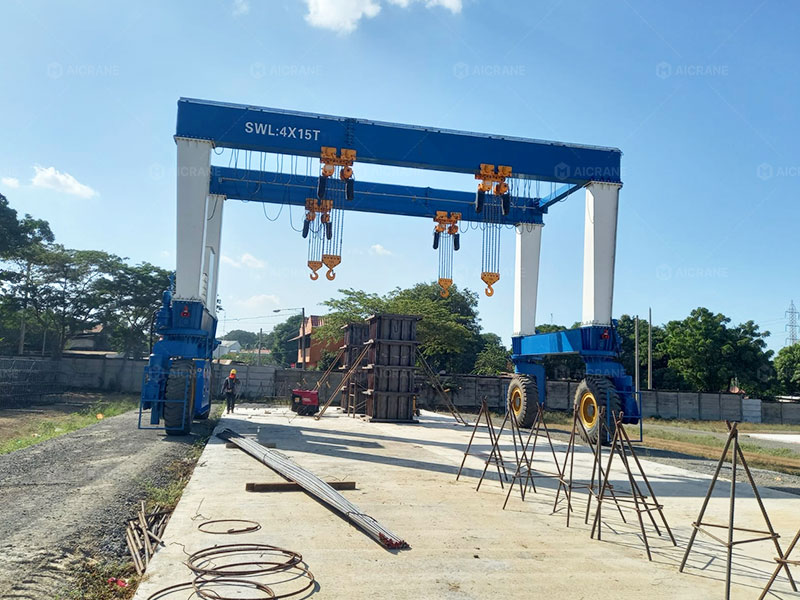
Physical Characteristics of Prefabricated Components and Material Handling Requirements
The technical specifications of rubber tyred mobile gantry cranes in prefabrication facilities are dictated by the physical attributes of precast and modular units.
Single precast elements and fully fitted volumetric modules typically range in mass from 20 to over 300 metric tons, with certain civil engineering components exceeding these figures. Furthermore, lengths frequently span from 10 to more than 40 meters. These dimensions often result in off-center centers of gravity and uneven load profiles. To handle such loads safely, lifting machinery must feature multi-point hoisting capabilities and real-time load redistribution functions to prevent excessive bending moments or torsional stresses during elevation and travel.
In addition, prefabricated modules exhibit high sensitivity to structural deformation and mechanical impact. Precast concrete elements that have not yet reached full design compressive strength, as well as volumetric MiC modules containing completed interior architectural finishes and mechanical, electrical, and plumbing (MEP) services, can suffer micro-cracking or interior damage if subjected to sudden acceleration, excessive tilt, or sway. Material handling machinery must therefore deliver smooth motion profiles, minimal structural deflection, and reliable low-speed inching control.
Facility footprint and spatial layout impose further operational constraints. Prefabrication yards are engineered to maximize storage density per unit area, resulting in narrow storage aisles and limited clearance. Equipment must operate within constrained corridors without relying on fixed rail infrastructure, requiring capabilities for lateral translation and zero-radius pivot turning. Ground conditions in temporary or permanent prefabrication yards typically consist of compacted gravel or paved asphalt/concrete pads; equipment axle configurations must distribute load effectively to remain within allowable soil bearing capacities.
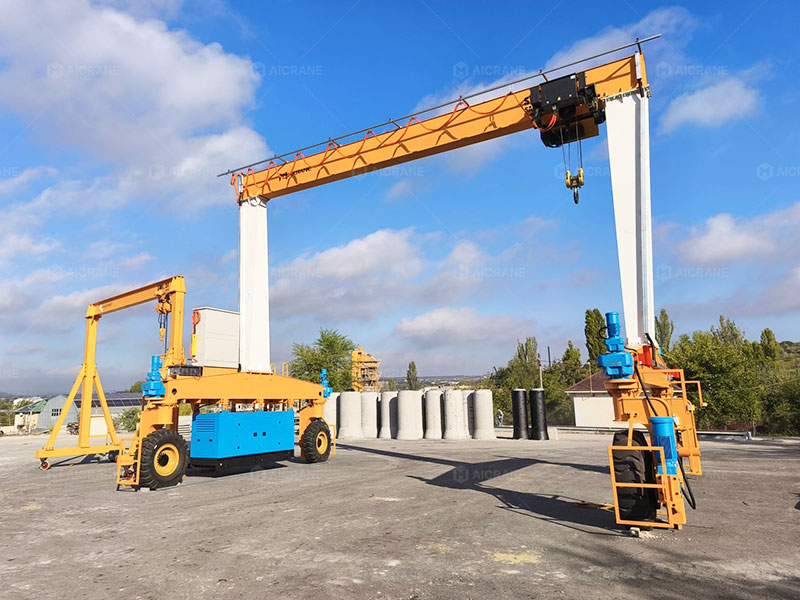
Structural Configuration and Control Technologies of RTGs
A Rubber-Tyred Gantry Crane comprises a structural steel portal frame, a hoisting mechanism, a trolley traverse system, a gantry travel mechanism with pneumatic rubber tyres, and an integrated electrical control system. To accommodate the requirements of prefabrication logistics, rubber tire cranes incorporate specific mechanical and electrical control features.
Multi-Mode Tyre Steering Systems
RTGs utilize multi-axis rubber tyre assemblies for structural support and mobility. Driven by hydraulic or electro-mechanical steering actuators, the gantry wheel sets can execute several distinct travel modes:
- Longitudinal and Transverse Travel: By slewing the gantry wheel sets 90 degrees, the crane transitions between different working bays or yard corridors without needing external turntables.
- Diagonal Travel (Crab Steering): Wheel angles are synchronized at an oblique angle, enabling side-to-side alignment correction or diagonal relocation along narrow pathways.
- Pivot and Carousel Turning: By driving the wheel groups on opposite sides in reverse directions, the RTG performs tight-radius turns or spins around its geometric center point, reducing required turning radii at aisle intersections.
Multi-Hoist Synchronization and Load Balancing
For long-span and asymmetric loads, RTGs are configured with dual trolleys or multi-winch hoisting systems. System synchronization is managed by a Programmable Logic Controller (PLC). Load cells and absolute encoders installed across the hoisting mechanisms capture real-time force vectors and vertical position data. The PLC processes these inputs and sends corrective control signals to variable frequency drives (VFDs) governing individual winch motors. This closed-loop control regulates motor speeds to maintain vertical height differences between lifting points within predefined tolerance limits, maintaining horizontal levelness throughout the lift.
Inching Capability and Anti-Sway Control
AC variable frequency drive systems provide stepless speed regulation across hoisting, trolley traverse, and gantry travel motions. During final component positioning and alignment with storage saddles or transport beds, the crane operates at micro-speeds down to 0.1 meters per minute. Electronic anti-sway control algorithms compute pendulum frequencies based on rope length and load characteristics, automatically adjusting trolley acceleration and deceleration profiles to suppress sway induced by inertia. This stabilizes suspended loads rapidly upon arrival at target coordinates, minimizing manual guy-wire intervention and cycle times.
Power Supply Configurations
RTG primary power systems are configured according to operational requirements, environmental regulations, and site infrastructure:
- Diesel Generator Sets: Provide complete operational independence from external power grids, suitable for temporary job-site prefabrication yards or remote infrastructure projects.
- Cable Reel or Busbar Systems: Connect directly to the industrial power grid, eliminating localized exhaust emissions and operating at reduced noise levels, ideal for permanent indoor or semi-enclosed prefabrication plants.
- Hybrid Power Systems: Combine a downsized diesel engine with a lithium-ion battery bank or supercapacitor module. The system captures regenerative energy during load lowering, supplementing peak power demand during heavy lifts and reducing overall fuel consumption.
Material Handling Workflow in Prefabrication Operations
RTGs perform specialized functions across the complete workflow of prefabrication logistics.
Formwork Stripping and Demolding
After precast concrete elements complete thermal curing and reach required stripping strength, an RTG positions itself over the casting bed. Specialized lifting beams or vacuum lifters attach to designated pickup points. In the initial elevation phase, the crane must overcome mechanical adhesion between the concrete element and the formwork liner. The low-speed inching system executes a strictly vertical lift at minimal velocity to prevent lateral contact or friction against side forms, maintaining edge integrity and surface finishes.
Yard Transfer and High-Density Stacking
Following demolding, the RTG transports components to the yard. The portal frame design provides vertical and horizontal clearance, allowing the rubber tyred straddle crane to travel over existing storage stacks. Depending on ground bearing capacities and element structural limits, components can be stacked three to five tiers high. Guided by spatial positioning systems, the RTG navigates narrow aisles, optimizing land utilization in the storage yard.
Transport Loading and On-Site Module Placement
During dispatch, the RTG lifts components from storage and places them onto flatbed semi-trailers, low-bed heavy haulers, or multi-axle hydraulic platform trailers. Utilizing anti-sway and micro-speed positioning, the crane aligns module connection points, guide pins, or twist-locks with vehicle mounting frames within tolerances of plus or minus 2 millimeters. In field prefabrication yards directly adjacent to building footprints, RTGs can also handle direct vertical placement of volumetric modules for low-rise structures.
Technical and Economic Comparison
Selecting material handling equipment for prefabrication projects involves evaluating RTGs against Rail-Mounted Gantry Cranes (RMGs) and Crawler Cranes across operational parameters:
Regarding site infrastructure requirements, RTGs operate on compacted gravel or standard reinforced concrete runways without dedicated rail foundations. This reduces initial civil works expenditure and accelerates yard setup time. Conversely, RMGs require fixed steel rail tracks with deep reinforced concrete sub-bases, restricting operation to defined rail corridors. Crawler cranes operate without fixed tracks but impose high ground bearing pressures, requiring heavy matting on soft ground and causing potential wear on paved surfaces during travel.
Regarding footprint efficiency, both RTGs and RMG cranes utilize portal frames, occupying ground space only along their narrow wheel paths or rail lines, leaving the central span available for high-density storage. Crawler cranes require substantial operational radii and tail-swing clearance during slewing, which increases unutilized buffer zones within the yard layout.
Regarding equipment mobility and relocation, RTGs can travel autonomously between different yard sectors and be reconfigured for new site layouts with minimal downtime. RMGs cannot depart from fixed track networks without extensive disassembly. Crawler cranes require multi-truck transport and prolonged setup times when relocating long distances or transferring between separated project sites.
Automation and Digital System Integration
Modern RTGs incorporate digital sensors and automation frameworks to integrate into prefabrication yard management networks.
Positioning and Navigation Systems
By combining Real-Time Kinematic Global Positioning System (RTK-GPS) modules, LiDAR sensors, and wheel rotary encoders, RTGs achieve horizontal positioning accuracy within centimeter tolerances. The system assists operators or executes semi-autonomous path planning to navigate to targeted component storage slots, reducing positioning errors and travel cycle times.
Yard Management System (YMS) Integration
The onboard Programmable Logic Controller communicates with the prefabrication facility’s Yard Management System (YMS) via industrial wireless networks. The crane receives digital task orders and updates component status upon completion of a move. By scanning auto-identification tags (such as RFID transponders or QR codes) attached to components during lifting, the system updates inventory databases with precise coordinate coordinates, supporting material traceability throughout the project lifecycle.
Condition Monitoring and Predictive Diagnostics
Sensors distributed across critical mechanical and electrical subsystems—including gearboxes, drive motors, structural strain points, and tyre pressure monitoring systems—continuously record operational parameters. Edge computing units process vibration spectra, temperature rises, stress cycles, and power consumption metrics. Diagnostic software analyzes these trends to evaluate mechanical health, forecast component service life, and schedule preventive maintenance, minimizing unplanned operational disruptions.
Conclusion
Rubber-Tyred Gantry Cranes address the material handling requirements of modular construction and prefabrication projects through rail-free mobility, versatile steering configurations, synchronized multi-hoist control, and precise positioning capabilities. Capable of handling heavy, elongated, and delicate structural components within footprint-constrained yards, RTGs enhance logistics efficiency when integrated with digital positioning and inventory management systems, serving as vital material handling infrastructure in modern prefabricated construction.