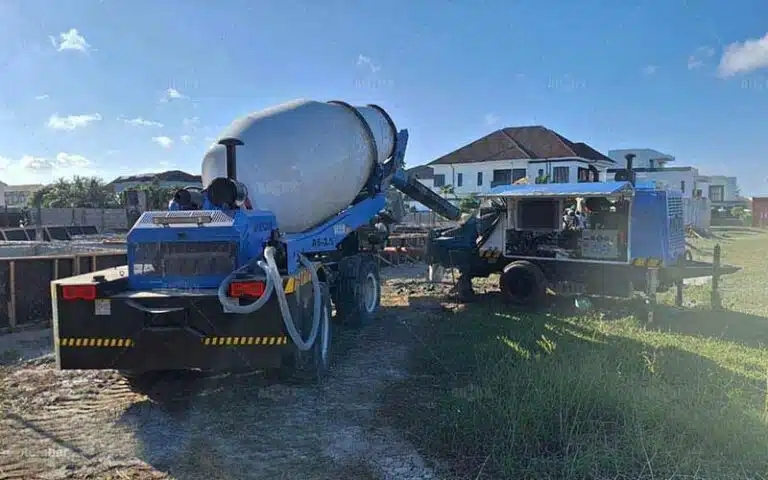
You’re a contractor in the middle of nowhere—say, building a culvert in Gembu, Taraba State, or laying pipes near the Chad basin. The nearest ready-mix plant is 150 kilometers away. The roads are a nightmare. You have no consistent power. Yet you need concrete. Quality concrete. Not the weak, slumpy mess that arrives after a six-hour truck journey. What do you do? You argue for a different solution. A self loading mixer paired with a trailer pump. This isn’t just equipment. It’s a lifeline. It’s independence from the broken supply chain. It’s the difference between finishing a project and abandoning it. I’m here to argue passionately that every remote site in Nigeria should deploy this combo. And I’ll tell you exactly why.
1. The Death of the Ready-Mix Truck in Rural Nigeria
The ready-mix truck is a beautiful machine. On a smooth highway, in a city with decent roads, it works wonders. But take it off-road? It dies. The drum’s rotating mechanism relies on a stable platform. When the truck tilts on a rutted path, the concrete segregates. The heavier aggregates sink to one side. The lighter cement paste floats. By the time the truck arrives, you have a useless mix of watery slurry at the top and dry stones at the bottom. Add water to make it flow? You destroy the water-cement ratio. The resulting concrete cracks within months. I’ve seen it. I’ve tested the cores. They crumble under a hammer.
1.1 The Economics of Haulage
Let’s do the math. A ready-mix truck carries 6 cubic meters. In Lagos, that’s fine. In Gembu, the truck spends two days on the road—one to get there, one to return. The driver demands demurrage. The fuel cost is astronomical. And the truck might get stuck. You need a second truck to pull it out. Suddenly, that 6 cubic meters costs you ₦1.5 million. That’s ₦250,000 per cubic meter. Madness. A self loading concrete mixer for sale in Nigeria produces that same concrete on-site for ₦50,000 per cubic meter, including materials. The difference is your profit. Why would anyone accept the truck? Only ignorance or laziness.
Furthermore, ready-mix suppliers hate remote sites. They’ll quote you a “mobilization fee” that doubles the price. Or they’ll simply say “no.” I’ve heard this story dozens of times from contractors in the North-East. The suppliers have a cartel. They prioritize high-volume urban clients. The remote contractor is an afterthought. Stop being an afterthought. Take control with your own batching and pumping combo.
1.2 Time is Not on Your Side
Concrete has a temper. It begins setting after 90 minutes, faster in hot weather. A six-hour journey means the concrete is partially set before it even reaches your formwork. You might think adding water solves it. It doesn’t. It creates capillary voids. The strength drops from 25 MPa to 15 MPa. That’s not a foundation; that’s a liability. With a self-loading mixer, you batch the concrete exactly when you need it. The materials are fresh. The water is measured. The mixer drum turns just enough to homogenize, not over-work. Then you pump it directly into the forms. The entire cycle—from loading to pouring—takes 20 minutes. That’s concrete at its peak. That’s how you build structures that last for decades.
2. The Trailer Pump: Your Concrete’s Best Friend
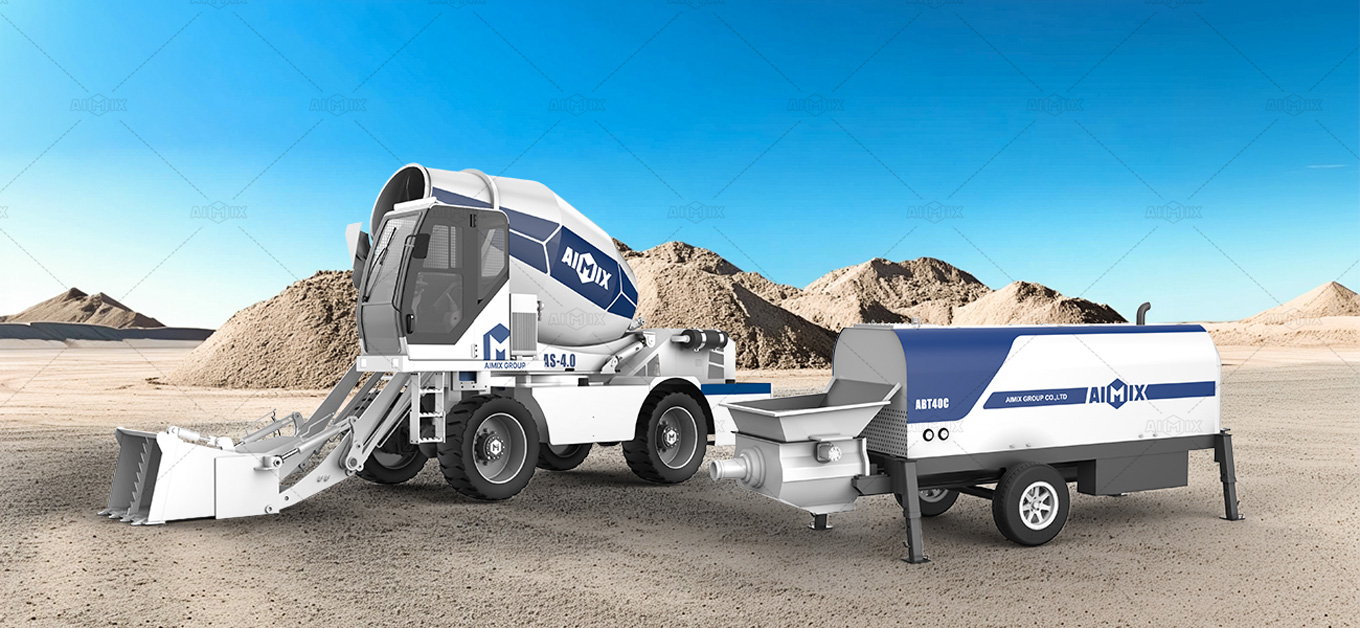
So, you’ve made the smart choice. You bought a self-loading mixer. Now you have a pile of concrete next to the machine. How do you get it into the forms? Wheelbarrows? That’s what amateurs do. Wheelbarrows spill material. They require a ramp. They tire out your laborers. And they’re slow. A trailer pump solves all of that. It’s a simple machine: a small diesel engine, a hydraulic system, and two pistons that push concrete through a hose. You place the pump next to the mixer’s discharge chute. You run a 50mm hose—50 meters, 100 meters, even 150 meters—directly to the point of placement. One operator. No wheelbarrows. No waste.
2.1 Reaching the Unreachable
Remote sites have challenging topography. You might be building a bridge abutment down a steep embankment. A mixer cannot drive there. Wheelbarrows would tip over. But a hose? The hose goes anywhere. It snakes around trees, drops down slopes, and reaches into deep excavations. I once saw a crew pump concrete 80 meters horizontally and then 15 meters vertically up a cliff face for a telecom tower foundation. Impossible with any other method. The trailer pump made it look easy. Furthermore, the pump’s output is controllable. You can throttle it down for small footings or open it up for large mats. The self-loading mixer produces batch after batch, and the pump never stops. It’s a symbiotic relationship.
Consider the labor savings. Without a pump, you need ten men with wheelbarrows. With a concrete pump for sale in Nigeria, you need two: one at the mixer to guide the chute, one at the hose end to direct the flow. Those eight extra men can be redeployed to rebar tying or formwork assembly. Your productivity soars. Your wage bill drops. And the men are happier because they’re not breaking their backs pushing heavy loads. That’s humane engineering. That’s caring for your workforce while improving your bottom line.
2.2 Maintenance Simplicity in the Bush
A trailer pump has no electronics. No PLC. No touchscreen. It has a diesel engine, a hydraulic pump, two pistons, and a set of valves. That’s it. When it breaks—and it will, eventually—any mechanic with basic tools can fix it. The piston cups are rubber. They wear out after 500 hours. Replacement cost? ₦5,000 each. The hydraulic oil needs changing every 500 hours. That’s ₦30,000. Compare that to a truck-mounted pump with a computerized boom. That machine requires a factory technician and specialized software. Good luck finding that in Gembu. The trailer pump is the AK-47 of concrete equipment. Crude, reliable, and fixable with a hammer and a wrench. That’s what you need in remote Nigeria.
2. The Synergy: Why the Combo is Greater Than the Sum
Separately, a self-loading mixer and a trailer pump are useful. Together, they are transformative. The mixer produces concrete exactly at the pump’s intake. The pump pushes it exactly where needed. No double-handling. No material loss. No time wasted. This synergy unlocks new possibilities. You can pour a kilometer of roadside drainage in a single day. You can build a water tower foundation without a single wheelbarrow trip. You can cast a generator house slab in a location that’s only accessible by foot. The combo turns your site into a miniature concrete factory. It’s mobile. It’s powerful. It’s independent.
3.1 Case Study: The Borno School Project
Last year, a contractor in Borno State was rebuilding a primary school that had been destroyed. The site was 40 kilometers from the nearest paved road. Ready-mix trucks refused to go. The contractor bought a used self-loading mixer and a Chinese trailer pump for a total of ₦28 million. Over six months, they poured 1,200 cubic meters of concrete—foundations, floor slabs, retaining walls. The material cost was ₦18 million (cement, aggregates, water). The total equipment cost amortized over the project was ₦5 million (assuming resale value of ₦23 million). Total cost: ₦23 million. If they had used ready-mix with haulage, the same volume would have cost ₦60 million minimum. The combo saved ₦37 million. That’s not a saving. That’s a miracle. The contractor used the extra money to build an additional classroom. That’s the power of arguing for the right equipment.
But wait, there’s more. The school project required concrete of different grades. Foundation: 30 MPa. Floor slab: 25 MPa. Retaining wall: 20 MPa. A ready-mix plant would have required three separate orders, three separate deliveries, three separate sets of quality control. The self-loading mixer allowed the contractor to switch grades instantly. Just change the cement quantity in the weighing hopper. The concrete trailer pump didn’t care. It pumped all grades equally. This flexibility is priceless on sites where space is limited and material storage is primitive. You don’t need three stockpiles of different aggregates. You need one stockpile and a brain. The combo provides the brain.
3.2 Overcoming the “No Electricity” Excuse
I hear this constantly: “We can’t use a pump because we have no power.” Nonsense. Both the self-loading mixer and the trailer pump run on diesel engines. They are completely self-sufficient. The mixer has a 50 hp diesel engine driving the drum and the loading arm. The pump has a 30 hp diesel engine driving the hydraulic system. No generator required. No grid connection. No extension cords. You just need diesel. And diesel is available even in remote areas—perhaps at a premium, but available. The combo turns electricity from a necessity into an irrelevance. That’s the ultimate freedom for a remote contractor. Stop making excuses. Start making concrete.
Conclusion: Stop Hauling, Start Making
The Nigerian construction industry has a blind spot. It thinks concrete must come from a central plant. That’s a city mentality. It doesn’t work in the bush. Remote sites need self-sufficiency. They need the self-loading mixer and trailer pump combo. This duo bypasses broken roads, eliminates haulage costs, defeats the ready-mix cartel, and puts control back in the contractor’s hands. The upfront investment is significant—₦25 million to ₦40 million for decent units. But the payback is rapid. One medium-sized project can recover the entire cost. After that, it’s pure profit. So, I’m arguing passionately: don’t beg for ready-mix deliveries. Don’t rely on wheelbarrows. Don’t accept delays. Buy the combo. Take it to the remote site. Show them what real concrete placement looks like. Your project timelines will shrink. Your quality will improve. Your reputation will grow. And you’ll never look back.