The landscape of modern infrastructure development is shifting. As urban centers become saturated, the focus of global engineering has moved toward remote regions—building bridges over deep ravines, laying high-speed rail lines across desolate plains, and erecting massive wind farms in high-altitude corridors. These projects share a common challenge: the logistical nightmare of heavy lifting in environments where traditional infrastructure, such as rail tracks or reinforced concrete foundations, simply does not exist.
Enter the Industrial Rubber Tyred Gantry (RTG) Crane. Once the exclusive domain of bustling container ports, the RTG has evolved into a versatile, mobile powerhouse that is becoming the “ultimate solution” for remote infrastructure sites. In this article, we explore why this machine is the preferred choice for engineers facing the world’s most challenging construction environments.
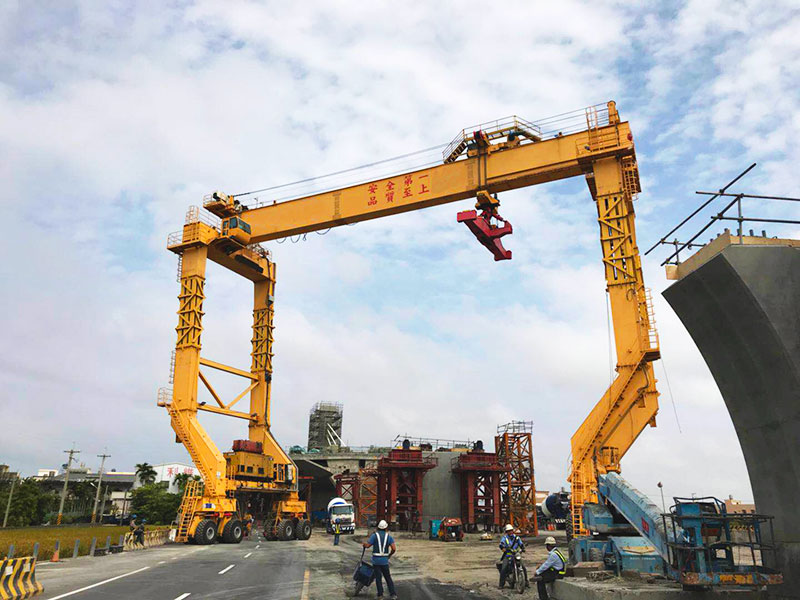
The Logistical Paradox of Remote Sites
In a typical industrial setting, heavy lifting is handled by overhead bridge cranes or rail mounted gantry cranes. However, these require permanent, level, and highly engineered tracks. In remote infrastructure projects—such as a highway bridge in a mountainous region—installing hundreds of meters of rail is cost-prohibitive and geographically impossible.
Traditional mobile truck cranes are an alternative, but they have limitations. They require massive outriggers, have a limited “pick-and-carry” capacity, and their stability decreases significantly as the boom extends.
The RTG crane solves this paradox. By combining the high lifting capacity of a gantry with the “go-anywhere” mobility of heavy-duty rubber tires, it provides a stable lifting platform that requires minimal site preparation.
1. The Power of “Trackless” Mobility
The most significant advantage of an RTG in a remote site is its independence from fixed infrastructure. Unlike its rail-mounted cousins, an RTG creates its own path.
Versatile Steering Modes
Modern industrial RTGs are equipped with multi-way steering systems. They can perform:
-
Straight Travel: For moving loads along a long precast yard.
-
90-Degree Transverse Steering: Allowing the crane to move sideways between different work bays.
-
Carrousel/Pivot Steering: Enabling the crane to turn on its own axis—a critical feature in the cramped confines of a mountain tunnel entrance or a narrow bridge pier site.
-
Crab Steering: For diagonal movement to precisely align a load.
This mobility means that as the project moves, the crane moves with it. When a section of a bridge is completed, the RTG can simply “drive” to the next staging area without the need to dismantle and reinstall complex rail systems.
2. Superior “Pick-and-Carry” Capabilities
In remote infrastructure, materials aren’t just lifted; they need to be transported. Whether it is a 100-ton precast concrete bridge girder or a 90-meter wind turbine blade, the ability to lift a load and carry it across the yard is essential.
Standard mobile cranes are often restricted by their load charts when moving. An RTG, however, is designed for constant stability. With a wide footprint and a low center of gravity, it can safely transport massive components over compacted gravel or stabilized soil. This eliminates the need for secondary transport vehicles (like multi-axle trailers) within the site, reducing both equipment costs and the risk of accidents during load transfers.
3. Precision Engineering in Challenging Climates
Remote sites are often synonymous with harsh weather. From the salt-heavy air of coastal bridge sites to the thin, freezing air of high-altitude rail projects, equipment must be resilient.
Intelligent Anti-Sway Technology
When lifting a bridge segment in a windy canyon, wind-induced sway is a major safety hazard. Modern RTGs utilize Electronic Anti-Sway Systems. By using AI-driven algorithms and encoders, the crane automatically compensates for movement, ensuring that the load remains perfectly vertical. This precision is vital when lowering a segment onto pins or bolts with millimeter tolerances.
Environmental Hardening
Industrial RTGs for remote sites are built with specialized coatings to prevent corrosion. Furthermore, their hydraulic and electrical systems are often equipped with “cold-start” kits or high-efficiency cooling systems to ensure they operate reliably in temperatures ranging from -20°C to +50°C.
4. Economic Efficiency and Reduced Site Prep
Cost is the primary driver of any infrastructure project. The “hidden” cost of heavy lifting is often the site preparation. To use a fixed gantry crane, you might need to pour thousands of tons of concrete for a foundation.
An RTG crane operates on compacted ground. While the ground must be level and capable of bearing the tire pressure, the requirements are significantly lower than those for permanent rail foundations.
-
Reduced Civil Works: Less concrete and steel are used for the yard itself.
-
Fast Deployment: Because they are often modular, RTGs can be shipped in containers and assembled on-site in a matter of days.
-
Resale and Relocation: Once a project is finished, the RTG can be driven onto a low-loader and moved to the next project, or sold on the global market, retaining a much higher percentage of its value than a custom-built rail system.
5. Bridging the Energy Gap: Hybrid and Electric Options
Remote sites often lack a stable connection to the power grid, forcing reliance on diesel generators. This presents both a cost and an environmental challenge.
The latest generation of RTGs addresses this through Hybrid Power Systems. These cranes use a smaller diesel engine combined with a lithium-ion battery pack. The battery handles peak loads (the initial lift), while the engine recharges the battery during idle time.
-
Energy Regeneration: When a heavy load is lowered, the motor acts as a generator, capturing the gravity-driven energy and pumping it back into the battery.
-
Fuel Savings: Hybrid RTGs can reduce fuel consumption by up to 30% to 50%, a massive operational saving when fuel must be trucked hundreds of miles to a remote site.
6. Case Study: The RTG in Bridge and Wind Infrastructure
Bridge Construction
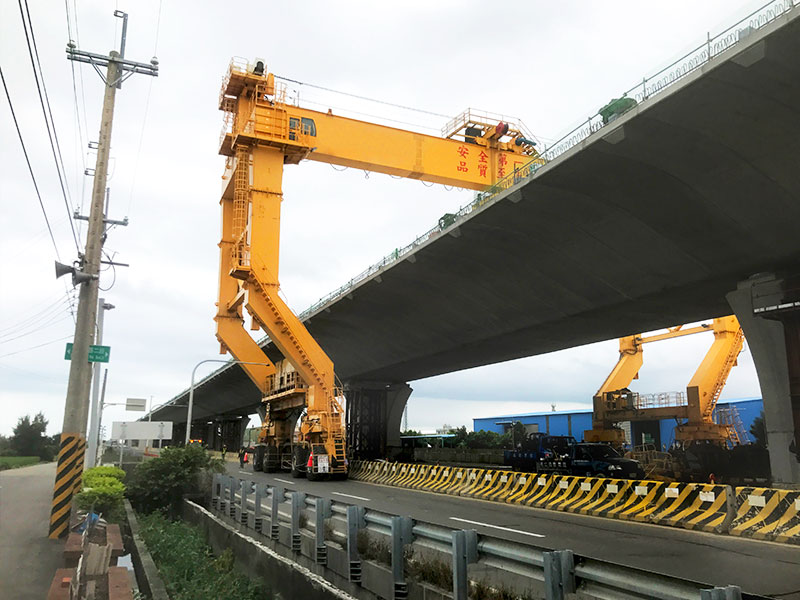
In the construction of the High-Speed Rail viaducts, RTGs are used in the “Precast Yard” located near the construction line. The RTG straddles the casting beds, lifts the cured concrete segments (weighing up to 150 tons), and stacks them efficiently. Its ability to move in any direction allows the yard to be organized with much higher density than a yard relying on truck cranes.
Wind Farm Logistics
As wind turbine components grow in size, traditional forklifts and reach stackers are no longer sufficient. An industrial straddle carrier can straddle a turbine nacelle or tower section, providing a stable 4-point lift that prevents the structural deformation of the component—a common risk with single-hook cranes.
7. Safety and Operator Comfort
In remote areas, medical help is far away, making safety the absolute priority. RTGs offer a safer environment than traditional mobile cranes:
-
Operator Visibility: The elevated cabin provides a 360-degree view of the work area, often supplemented by 3D-camera systems that eliminate blind spots.
-
Automatic Load Monitoring: Real-time data prevents the operator from attempting a lift that exceeds the crane’s capacity or center-of-gravity limits.
-
Remote Operation: In particularly dangerous environments (e.g., handling hazardous materials or unstable terrain), RTGs can be operated via a Remote Control Station, removing the human operator from the danger zone entirely.
Conclusion: The New Standard for Heavy Logistics
As we look toward the infrastructure goals of 2030 and beyond, the complexity of our projects will only increase. The Rubber Tyred Gantry crane has successfully migrated from the port to the industrial heartland, proving that mobility and power are not mutually exclusive.
For any project manager overseeing a remote infrastructure site, the RTG offers a compelling ROI. It reduces the need for permanent infrastructure, slashes fuel costs through hybrid technology, and provides a level of precision and safety that traditional cranes cannot match. In the battle against geography and physics, the RTG is indeed the ultimate solution.
Key Technical Specifications to Consider:
| Feature | Benefit for Remote Sites |
| Span Capacity | Can straddle multiple rows of materials, saving space. |
| Gradeability | Ability to operate on slight inclines (typically up to 1%–3%). |
| Steering Precision | Within ±5cm with GPS-assisted auto-steering. |
| Maintenance | Long service intervals (500+ hours) suitable for remote locations. |