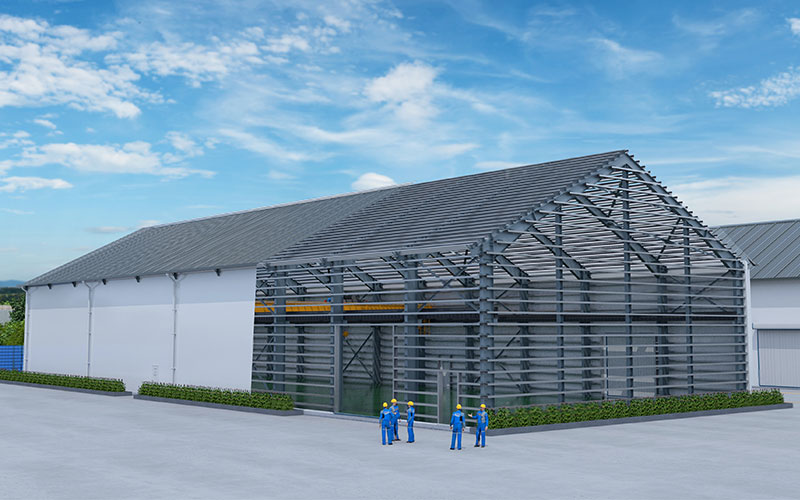
Steel structure workshops are widely used across manufacturing, metal processing, automotive, machinery production, logistics, and heavy industrial applications. In many of these industries, overhead cranes—such as single-girder cranes, double-girder cranes, European-style cranes, or heavy-duty process cranes—are essential for lifting and moving materials efficiently within the building. When a workshop is designed to support cranes, the structural requirements become fundamentally different from those of a non-crane workshop. A crane-ready steel structure must incorporate enhanced load-bearing capacity, precise detailing, and safe load transmission paths to ensure stable and reliable crane operation throughout the building’s life cycle.
This article explains the structural requirements, design considerations, and best practices for developing a high-performance crane-ready steel structure workshop. It is intended for workshop investors, engineers, equipment suppliers, and project managers who need a clear and practical understanding of how to properly design a workshop that integrates overhead lifting systems.
1. Why Crane-Ready Workshops Require Special Structural Design
An overhead crane introduces dynamic loads, sudden impact loads, lateral forces, vibration, and repeated fatigue stresses into the workshop’s steel framework. Unlike static loads from roof or wall cladding, crane loads constantly move along the shop floor and affect columns, beams, bracing systems, and connections.
Key challenges include:
-
Vertical loads from lifted materials, trolley weight, and crane self-weight.
-
Horizontal surge forces generated when the crane accelerates, decelerates, or handles swinging loads.
-
Longitudinal forces transmitted to runway beams and columns when the crane travels.
-
Impact and dynamic factors which increase the effective load impact on structural components.
-
Fatigue stresses caused by repeated movements and operational cycles.
Only workshops designed with proper crane integration can maintain long-term structural safety, reduce maintenance costs, and prevent crane instability or deformation of the building.
2. Determining the Right Crane Type for the Workshop
Before structural design begins, the workshop overhead crane type must be clearly defined. Four major categories influence workshop structure differently:
2.1 Single-Girder Overhead Crane
-
Light to medium duty (1–20 tons typically)
-
Requires lighter runway beams
-
Suitable for workshops with limited height
-
Lower building cost
2.2 Double-Girder Overhead Crane
-
Medium to heavy duty (5–500 tons)
-
Requires strong runway beams and columns
-
Suitable for large spans, high lifting heights, and frequent lifting
-
Offers better stability and higher lifting accuracy
2.3 European Standard Overhead Crane (FEM / DIN Design)
-
Lighter self-weight due to optimized design
-
Lower wheel pressure reduces building steel consumption
-
Suitable for modern automated workshops with high efficiency requirements
2.4 Process Cranes for Heavy Industry
-
Used in steel mills, foundries, power plants, and precast factories
-
Continuous heavy lifting, often high-temperature or dusty environments
-
Require special reinforcement, heavy-duty columns, and precise deflection control
The structural system must be selected according to crane capacity, working grade, operating frequency, and application scenario.
3. Key Structural Components in a Crane-Ready Steel Workshop
3.1 Runway Beams
Runway beams (also called crane beams) support crane wheels and carry vertical, lateral, and impact loads.
Design considerations include:
-
Section type: typically H-beams, welded box beams, or special wide-flange beams
-
Deflection limits (strict for smooth crane travel)
-
Stiffeners at wheel load points
-
Strong connections to columns to avoid torsion or bending failures
-
Anti-uplift devices in high-speed crane systems
The runway beam design is one of the most critical elements in the entire crane-ready building.
3.2 Columns and Column Bracing
Columns must carry extra bending moments and shear forces transferred from runway beams.
Requirements:
-
Increased column sizes and thickness
-
Proper base plate and anchor bolt reinforcement
-
Strong column-bracing systems to handle horizontal crane forces
-
Double-column systems when multiple cranes operate simultaneously
-
Portal frame reinforcement for multi-span workshops
Column alignment tolerance is extremely critical for crane installation and long-term travel stability.
3.3 Crane Rail and Rail Support Systems
Crane rails must be accurately aligned to ensure smooth crane movement.
Key points:
-
Rail type: square bar, DIN standard rails, or QU series rails
-
Continuous support with no gaps
-
Rail clips, pads, and adjustable fasteners
-
Rail deformation control under high wheel pressure
-
Allowable rail deflection and alignment parameters
Proper rail installation significantly increases crane operating life and reduces wheel wear.
3.4 Building Frame and Lateral Stability Systems
The crane loads introduce lateral forces that must be transferred safely to foundations.
Typically used systems include:
-
Roof bracing
-
Wall bracing
-
Horizontal bracing between beams
-
X-shaped bracing in end bays
-
Portal bracing when the workshop has few braced bays
-
Rigid frames for heavy-duty applications
A strong lateral system prevents sway, reduces vibrations, and ensures that crane operation does not distort the building.
3.5 Foundations and Anchor Connections
The foundation must support increased loads due to crane operation.
Important design considerations:
-
Larger foundation pads for crane columns
-
Higher steel reinforcement density
-
Stable anchor bolt configuration to prevent column base movement
-
Control of settlement to avoid misalignment of crane rails
-
Foundation beams or tie beams for better load distribution
For workshops using multiple large overhead cranes simultaneously, foundation design must include cumulative crane loads.
4. Workshop Dimensions and Their Relationship to Crane Design
4.1 Height
Workshop height must accommodate:
-
Lifting height
-
Hook approach
-
Trolley size
-
Hanger or special lifting devices
-
Future capacity expansion
Under-designing height is one of the most common and costly mistakes.
4.2 Span
Workshop span must consider:
-
Crane type: gantry mechanisms inside building vary by girder type
-
Wheel pressure and runway beam strength
-
Material flow requirements
-
Space for machinery, storage, vehicles, and processing zones
Larger spans require stronger rafters and more robust column structures.
4.3 Bay Length
Longer bays allow more flexible crane movement and larger production workflows.
However, long bay lengths require:
-
Stronger bracing systems
-
More precise alignment control
4.4 Clearances
Clearances are extremely important for:
-
Crane installation space
-
Maintenance space
-
Equipment replacement
-
Safe hook travel and overturning radius
5. Deflection and Vibration Control
Overhead cranes require stringent control of structural deformation.
Typical design requirements include:
-
Runway beam deflection limits under vertical load
-
Roof beam deflection limits under full crane load
-
Control of vibration frequency to avoid oscillation with crane movement
-
Limiting lateral drift at column tops
-
Periodic inspection and adjustment of alignment
Deflection control is essential for safe and reliable long-term crane operation.
6. Safety and Future Expansion Considerations
A crane-ready steel workshop also needs:
-
Anti-collision buffers and end stops
-
Safe access platforms for rail inspection
-
Catwalks for crane maintenance
-
Ladders and walkways
-
Future-proof capacity options (e.g., column brackets for future crane upgrades)
-
Space for additional rails or wider spans if future expansion is expected
Designing for future crane upgrades can significantly reduce future reconstruction costs.
7. Conclusion
A crane-ready steel structure workshop is much more than a standard steel frame building. It requires precise engineering, reinforced structural systems, optimized load paths, and meticulous detailing to support safe and efficient crane operations. From runway beams and columns to bracing, rail systems, and foundations, every component must be carefully designed to handle dynamic and repetitive crane loads. Additionally, selecting the right crane type, defining accurate building dimensions, planning for deflection control, and considering future expansion are all critical steps toward building a high-performance industrial facility.
By integrating crane requirements from the initial design stage, investors and engineers can achieve a workshop that offers high lifting efficiency, long-term structural durability, reduced maintenance costs, and maximum operational safety.